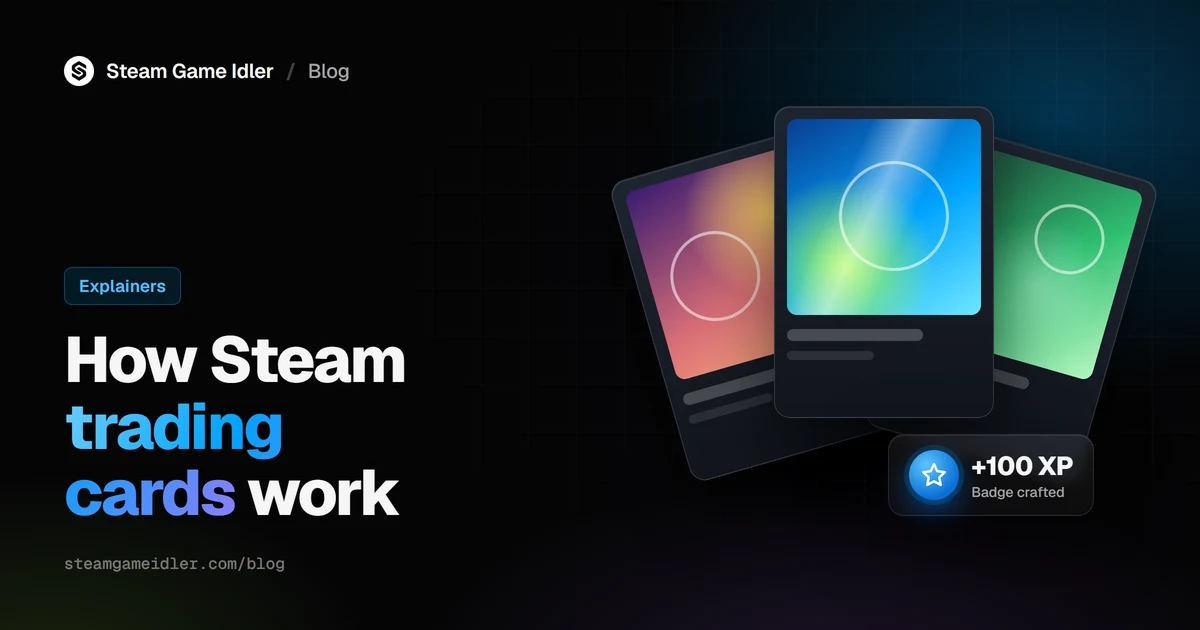
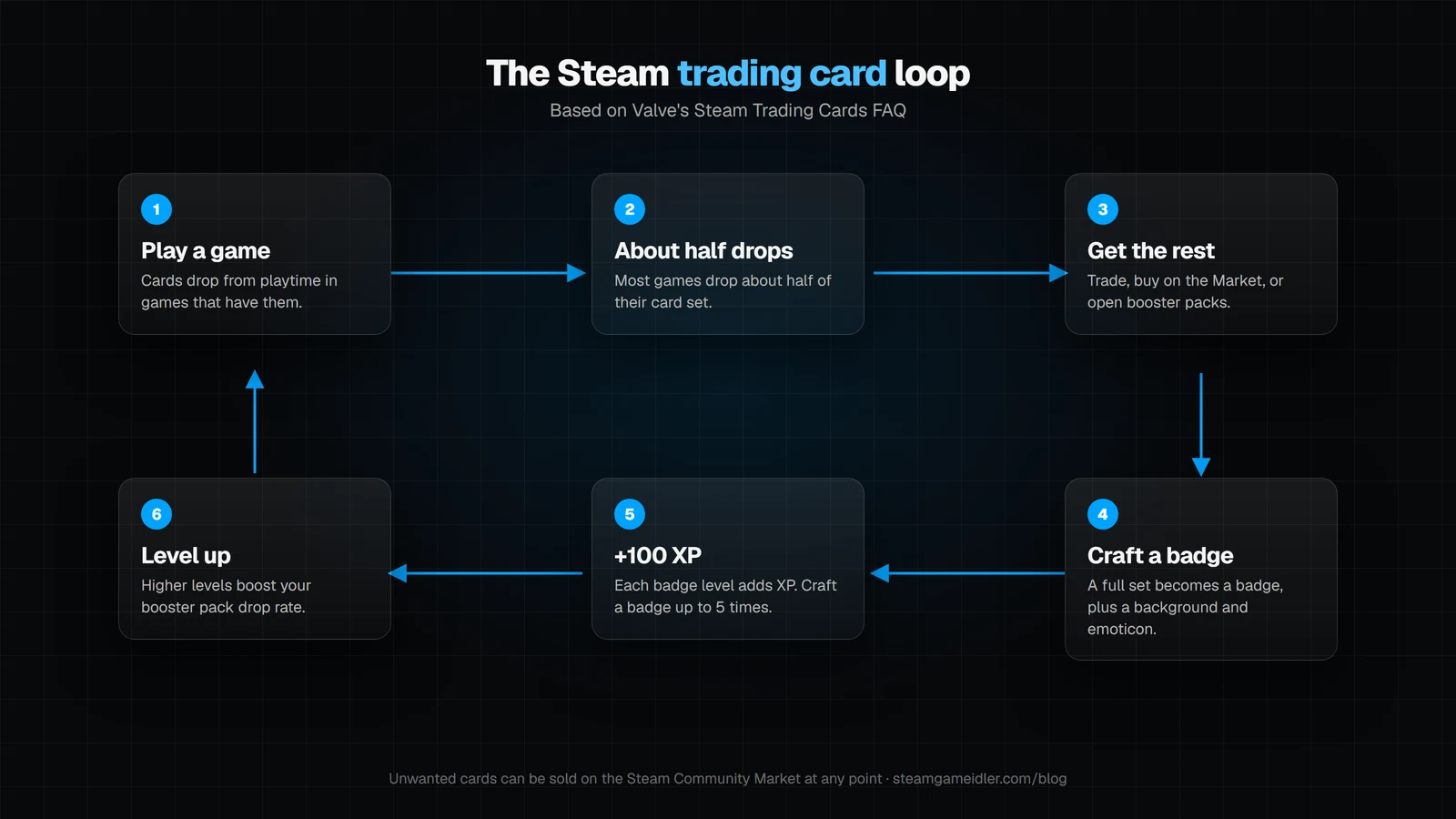
Steam trading cards are collectible items you earn by playing games that support them. Each game drops about half of its card set while you play. You collect the rest by trading, buying from the Community Market, or opening booster packs. A complete set can be crafted into a badge that gives you 100 XP toward your Steam level, plus a profile background and an emoticon. Any card you don't want can be sold on the Community Market for Steam Wallet funds.
How card drops work
You earn card drops by playing a game that has trading cards. According to Valve's Steam Trading Cards FAQ, "most games will drop a number of cards equal to about half the number of cards in that game's set." A game with an 8-card set drops about 4 cards, so you can never complete a set from drops alone.
A few rules shape when and how cards drop:
- Drops come from playtime, not achievements. Unlocking achievements doesn't earn cards.
- Free-to-play games work differently. Games like Team Fortress 2 and Dota 2 drop roughly one card for every $9 USD spent in the game, instead of from playtime.
- New games may not drop cards right away. Since May 2017, Valve has held back drops for new games until they pass a "confidence metric" showing that real players are buying and playing them. When a game passes it, cards drop for playtime you'd already logged. Valve added this to fight "fake" games that bot accounts idled only to farm cards.
- Your account must not be limited. Steam's Limited User Accounts page lists "Gaining Steam Profile Levels (Locked to level 0) and Trading Cards" among the restricted features. Spending at least $5 USD on Steam lifts that restriction.
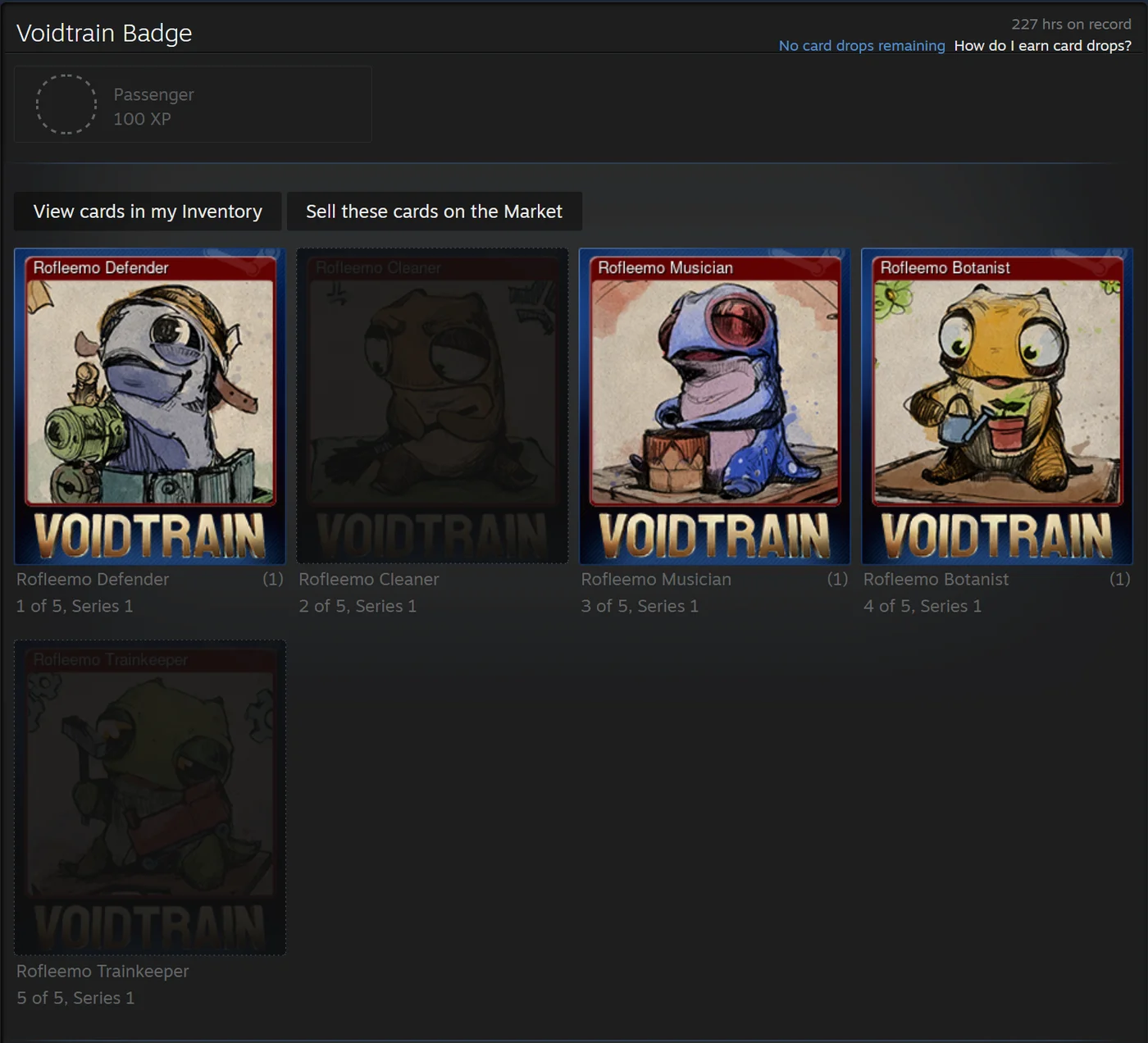
You can see how many drops a game has left on its badge page under your profile's Badges. If cards stop dropping when you expect them, our card drop times guide covers the usual causes.
Booster packs
Booster packs are how you keep getting cards after a game's drops run out. Valve's FAQ explains that once you've received all of a game's card drops, you become eligible for booster packs. Each pack contains 3 cards, which may include foils.
Booster packs aren't guaranteed. Steam grants them randomly to eligible players as other people in the community craft badges. To stay eligible you need to sign in to Steam at least once a week. Your Steam level also raises your chances: +20% at level 10, rising by 20 percentage points every 10 levels to +100% at level 50.
Crafting badges
A badge is what you get for completing a game's card set. Crafting one uses up the cards in the set and gives you:
- The game's badge on your profile
- 100 XP toward your Steam level
- A random emoticon and a random profile background from that game
- A chance at a discount coupon for another game or DLC
You can craft the same game's badge up to five times. Each extra craft needs another full set, gives another 100 XP, and raises the badge's level. Your Badges page shows your progress on every set, which friends have the cards you're missing, and a shortcut to trade with them.
Steam levels and XP
Your Steam level goes up as you earn XP, and crafting badges is the main way to earn it. Each level takes 100 XP at first, and the XP needed per level goes up every 10 levels: 200 after level 10, then 300 after level 20.
Leveling up has some real benefits on Steam:
- Your friends list limit goes up by 5 every level.
- You unlock an extra profile showcase every 10 levels.
- Your chance of booster pack drops goes up, as described above.
Years of Service and Steam Community badges also give XP, but for most people a higher Steam level means crafting a lot of trading card badges. Our guide to how to level up on Steam covers every XP source and what it costs.
Foil cards
Every card has a small chance of dropping as a foil, a rarer version with a shiny border. A full set of foil cards crafts into a foil badge. Valve's FAQ says foil badges carry no extra benefit beyond rarity.
Selling and trading cards
Cards are ordinary Steam inventory items, so you can trade them with friends or sell them on the Steam Community Market. This is how many players turn cards from games they don't care about into Steam Wallet funds to put toward new games. Steam's Community Market FAQ lists two fees on a sale:
| Fee | Who sets it | Amount |
|---|---|---|
| Steam Transaction Fee | Steam | 5% (minimum $0.01) |
| Game-specific fee | The game's publisher | 10% for Valve's own games, set per publisher |
Both fees are charged on top of the price you receive, so the buyer pays more than you get. Our marketplace fees page shows what you'll actually take home. Trades are final, as Valve's FAQ puts it: "make sure you really want to make a trade before confirming." Limited accounts can't use the Market or trade at all.
How Steam Game Idler fits in
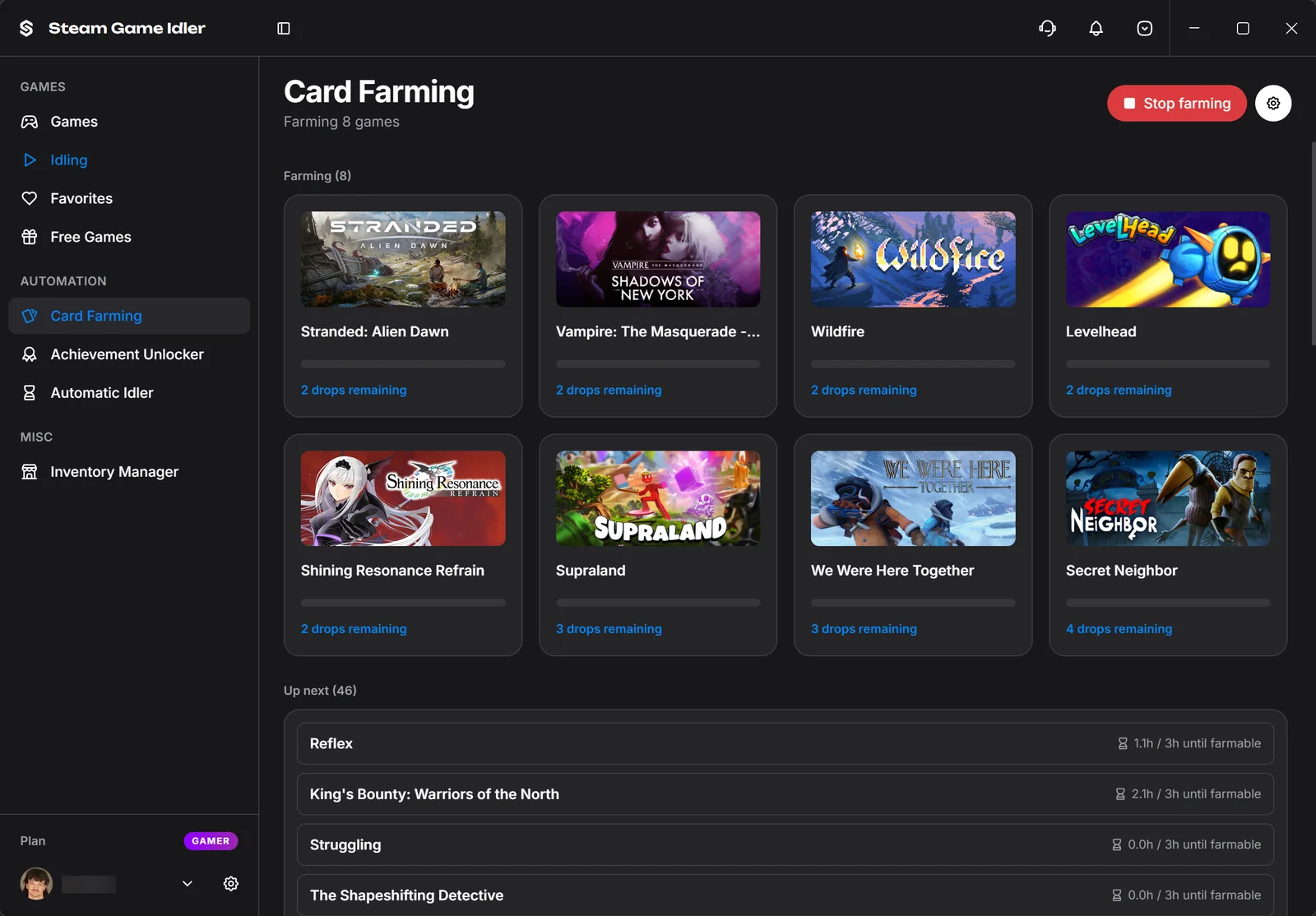
Card drops only need a game to be running on your account, which is why idling tools exist. Steam Game Idler's Card Farming works through every game in your library that still has drops left, without you downloading or playing them. For accounts that need some playtime before cards start dropping, it builds that playtime in batches of up to 32 games first, then farms each game until its drops are used up. Our how card farming works page explains the details.
When the cards are in your inventory, the Inventory Manager can list them on the Community Market. It accounts for the fees for you: the price you enter is the price the buyer pays.
Both features are free. Download Steam Game Idler to see how many card drops your library still has.
FAQ
How many trading cards can you get from one game?
Most games drop about half of their card set, according to Valve. A game with 10 cards in its set drops about 5. The rest come from trading, the Community Market or booster packs. Free-to-play games drop cards based on in-game spending instead.
Do you get trading cards for free games?
Free-to-play games such as Team Fortress 2 and Dota 2 drop cards based on money spent in the game, roughly one card per $9 USD, not on playtime. Your account also has to be out of Limited status (at least $5 USD spent on Steam) to receive cards at all.
Why am I not getting Steam trading cards?
The usual causes are a limited account, a game with no drops left, a new game that hasn't passed Valve's confidence metric yet, or not enough playtime yet. Our card drop times guide goes through each one.
What do you get for crafting a Steam badge?
You get the badge, 100 XP, a random emoticon and profile background from that game, and a chance at a discount coupon. You can craft each game's badge up to five times.
Are Steam trading cards worth any money?
They can be sold on the Steam Community Market for Steam Wallet funds, which you can spend on games and items on Steam. Prices vary by game and card, so check the Market listing for the cards you have. Steam's 5% fee and the publisher's fee are charged on every sale.
Do achievements give trading cards?
No. Valve's FAQ is clear that card drops come from playtime, not achievements.
Sources
- Valve, Steam Trading Cards FAQ, accessed October 20, 2026.
- Valve, Changes to Trading Cards, May 16, 2017.
- Steam Support, Limited User Accounts, accessed October 20, 2026.
- Steam Support, Community Market FAQ, accessed October 20, 2026.
- Trading Cards
- Badges
Creator and maintainer of Steam Game Idler.